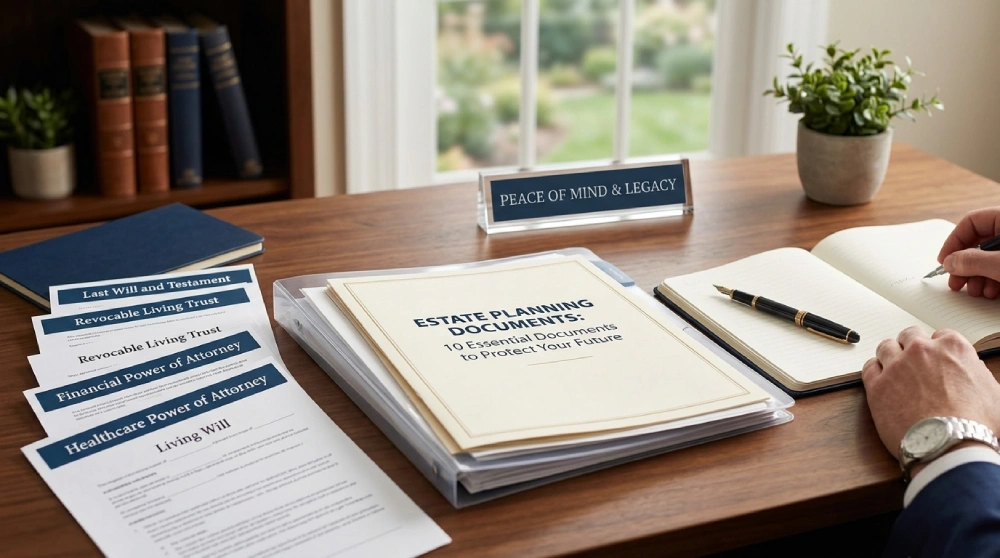
Estate planning documents help you decide how your assets, finances, healthcare decisions, and other personal matters should be handled during your lifetime and after your death. The right documents can help communicate your wishes and give trusted people the authority to act when needed.
While it will depend on your family, assets and state laws, there are a few documents that are usually part of a comprehensive estate plan.
What Are Estate Planning Documents?
Estate planning documents are legal documents that detail the distribution of your assets, finances, healthcare wishes and other personal matters.
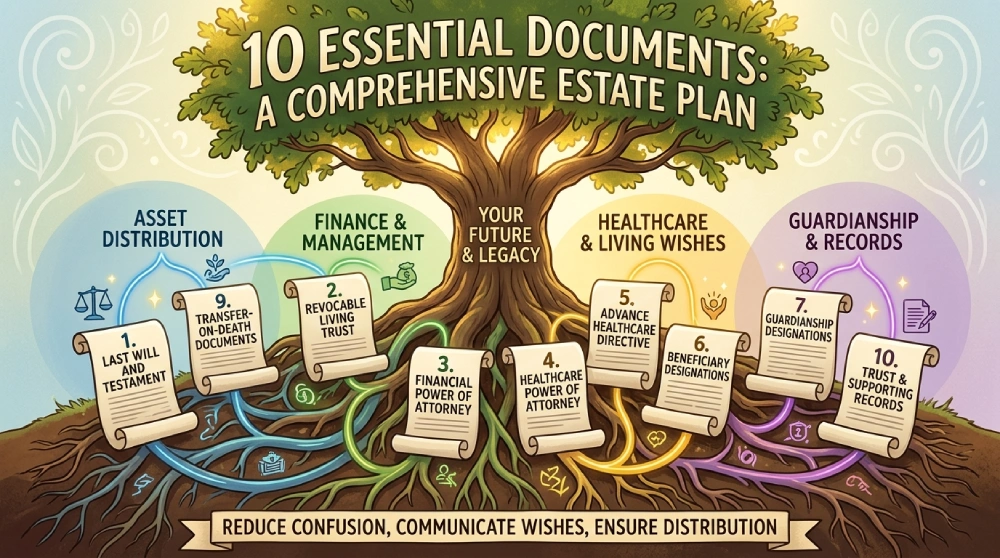
A well-organized estate plan can reduce family confusion and help ensure your wishes are clearly understood and followed.
1. Last Will and Testament
A will is a document that details the distribution of assets after someone passes away. It may also appoint an “executor” and (as applicable) guardians of minor children.
While many estate plans include a will, some assets are not subject to the will’s control as a result of beneficiary designations or certain trusts.
2. Revocable Living Trust
A revocable living trust is a trust set up during your lifetime, with the power to be revoked and generally the power to be controlled by you.
When properly structured and funded, a trust can provide for management of your assets in the event of your incapacity and may also be able to avoid probate for assets that are transferred to the trust.
3. Financial Power of Attorney
A financial power of attorney allows another person to have authority to manage some financial issues for you.
If you are no longer able to deal with bills, banking, property or other financial matters, the document can be used to help that person do so.
4. Healthcare Power of Attorney
This is a healthcare power of attorney, which means you’ll be able to designate a healthcare representative to make medical decisions for you if you’re not able to communicate or make the decisions yourself.
The level of authority will vary based on the document and the pertinent state statute.
5. Advance Healthcare Directive
An advance healthcare directive contains medical directions and may include preferences for medical directions in the event of serious illness or loss of capacity.
It can be used in conjunction with a health care power of attorney to voice your wishes and the health care power of attorney’s wishes.
6. Beneficiary Designations
Beneficiary designations are often used in life insurance policies, financial accounts and retirement accounts.
The designations can be used to designate who is to receive the account when it is passed on according to the overall estate plan; they should be reviewed periodically and remain consistent with the overall estate plan.
7. Guardianship Designations
Estate planning can be used by parents to designate a guardian for minors. While a court can finally make the appointment, having it clearly stated can offer significant guidance.
8. Living Will
A living will communicates your wishes about certain medical treatments and end-of-life care. Unlike a traditional will, which typically deals with property and other issues after someone’s death, it is a document that deals with specific issues.
Healthcare Documents at a Glance
| Document | Main purpose |
| Healthcare Power of Attorney | Names someone to make healthcare decisions |
| Advance Healthcare Directive | Communicates healthcare instructions and preferences |
| Living Will | States certain wishes about medical treatment and end-of-life care |
9. Transfer-on-Death Documents
Some accounts and assets can be transferred on death. These may be useful for transferring assets directly to named beneficiaries before they pass through the normal process of transferring assets via a will.
Available and subject to rules, which vary by asset type and State.
10. Trust Legal Documents and Supporting Records
Estate plan documents, trust agreements, amendments, property records, account information, insurance documents and other estate plan legal documents can help to keep an estate plan organized.
Having necessary documents close to one another can help representatives and family members understand what is available and where to locate documents.
Does a Will Have to Be Notarized?
Whether a will has to be notarized depends on state law. In many jurisdictions, notarization is not required for a will to be valid, although a notarized self-proving affidavit may simplify the probate process.
Because requirements differ, check the rules that apply where the will is executed.
Can a Notary Do a Will?
A notary typically certifies and carries out official notarial duties. Being a notary public does not automatically authorize someone to draft a will or provide legal advice about one.
State laws and the document will determine whether a notary may perform a specific act in connection with a will.
Who Can Notarize Wills and Estate Planning Documents?
An authorized commissioned notary may notarize an eligible document when the applicable legal requirements are met.
An estate planning notary performing an authorized notarial act should follow applicable identification, witnessing, recordkeeping, and notarization requirements. A notary’s role does not replace legal advice from an estate planning attorney.
What Is the Point of a Notary in Estate Planning?
A notary can help verify a signer’s identity and acknowledge or witness a signature when authorized by law. Notarization may provide evidence that the required notarial act was completed, but it does not replace legal advice or guarantee that an estate planning document is legally valid.
Estate Planning Documents Checklist
Use this estate planning documents checklist as a starting point:
- Last will and testament
- Revocable living trust, when appropriate
- Financial power of attorney
- Healthcare power of attorney
- Advance healthcare directive
- Living will
- Beneficiary designations
- Guardianship designations
- Transfer-on-death arrangements, when available
- Trust and supporting records
Review the documents after major life events such as marriage, divorce, the birth of a child, a major asset purchase, or a significant change in financial circumstances.
Conclusion
A well-crafted estate plan can clarify financial and health-care decisions for you and your family. There are a number of different types of estate planning documents, each with a specific function.
Legal requirements differ from state to state so it is important to have professional legal counsel to help prepare, sign and keep documents correctly.
Frequently Asked Questions
Does a will have to be notarized?
Not always. That the notarization is necessary is dependent upon the state law. There are some wills that can be valid without being notarized, and a self-proving affidavit, if notarized, can help the probate process.
Can a notary do a will?
A notary can carry out actions that are authorized for them under the law in the context of a document that is eligible for notarial acts but the notary’s job is not to write a will. You may need legal guidance and paperwork, which might require the services of a competent lawyer.
Can notaries do wills?
Notaries generally do not have the authority to provide legal advice simply because they are notaries. Their role is usually limited to performing authorized notarial acts.
Can you notarize a will?
A will may be notarized in some circumstances, but notarization requirements vary by jurisdiction. Some states require witnesses rather than notarization for a will to be properly executed.
Who can notarize wills?
An authorized commissioned notary may notarize a document when the applicable legal requirements are met. The exact rules depend on the state and the type of document involved.
What does an estate planning notary do?
An estate planning notary performs authorized notarial acts, such as verifying identity and witnessing or acknowledging signatures when required. The notary does not replace an estate planning attorney.
What is the point of a notary for estate planning documents?
Notarization can provide evidence that a person properly acknowledged or signed a document. It can also satisfy specific legal requirements for certain estate planning documents.
What documents should be included in an estate planning documents checklist?
A typical checklist may include a will, trust when appropriate, financial and healthcare powers of attorney, healthcare directives, beneficiary designations, guardianship instructions, and supporting records.
Are trust legal documents notarized?
Some trust-related documents may require notarization, while others may not. The requirements depend on the document, its purpose, and applicable state law.
